

Table of Contents
- Why Vegan Skincare Rituals Help You Unwind
- Building a Mindful Skincare Routine for Stress Relief
- Choosing Calming Skincare Products for Sensitive Skin
- Your Evening Skincare Ritual for Relaxation
- Creating a Relaxing Bath and Skincare Routine
- Essential Oil Safety and Fragrance Sensitivity
- How to Measure Results Without Overpromising
- Conclusion
- Frequently Asked Questions
Last Updated: October 16, 2026
Why Vegan Skincare Rituals Help You Unwind
Vegan skincare rituals for stress relief work because they slow you down. A calming routine gives your hands and senses something gentle to focus on.
Stress shows up on your skin. Many people notice breakouts, redness, or dryness during hard weeks. The link works both ways. Tense skin feels worse, and that tension feeds more stress.
Here is the honest part. No cream erases stress. What a ritual can do is give you a daily pause. That pause is where the real relief lives.
Building a Mindful Skincare Routine for Stress Relief
A mindful skincare routine is any set of steps you do slowly and on purpose. The goal is not perfect skin. The goal is a few quiet minutes that belong only to you.
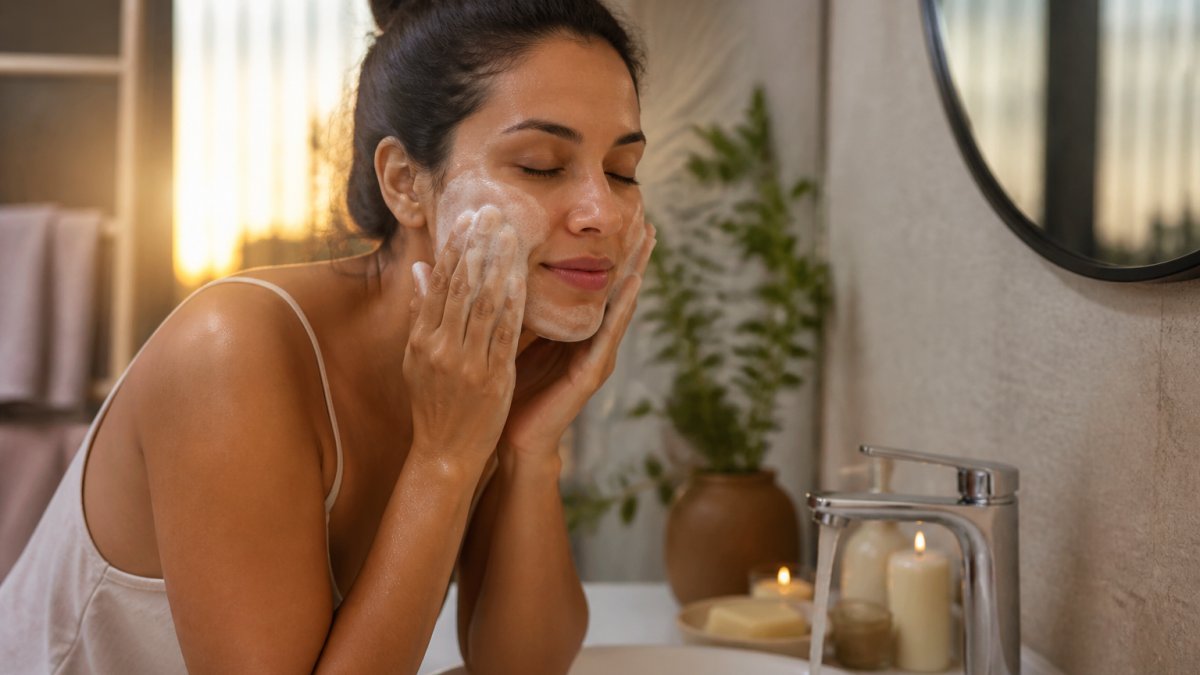
Start with three rules:
- Put your phone in another room
- Dim the lights or light one candle
- Move at half your normal speed
Most guides rush past this part. In practice, the pace matters more than the products.
Setting Your Space and Slowing Down
Your space sets the tone. A cluttered counter keeps your mind busy. Clear it first, then lay out only what you need tonight.
Small changes help:
- Warm the room slightly
- Play one calm playlist, no skipping
- Keep a soft towel within reach
Breathe out longer than you breathe in. Try a four-count in, six-count out. Do this three times before you touch your face.
Timing Your Ritual for Maximum Calm
The best time for an evening skincare ritual for relaxation is 30 to 60 minutes before bed. This window lets your body shift toward sleep.
Aim for 10 to 15 minutes total. Longer is fine on slow nights. Shorter is fine when you are tired. Consistency beats duration every time. Skipping a night is not a failure. Quitting the habit is the only real risk.
Choosing Calming Skincare Products for Sensitive Skin
Calming skincare products share a few traits. They have short ingredient lists, mild or no added fragrance, and no harsh drying agents. For sensitive or mature skin, simple formulas are usually safer than complex ones.
But the keyword here is vegan, and that word does more work than most shoppers realize. Vegan and cruelty-free are not the same claim, and neither one is regulated the way you might assume.
Vegan vs. cruelty-free: what each claim actually means
- Vegan describes ingredients. A vegan formula contains no animal-derived ingredients and no animal byproducts.
- Cruelty-free describes testing. A cruelty-free brand states it did not test the finished product or its ingredients on animals.
- A product can be one without the other. A formula can be cruelty-free but still contain beeswax, honey, lanolin, or carmine. A formula can be vegan but sold by a parent company that tests elsewhere.
In the United States, the FDA's guidance on cosmetics labeling explains that terms like "natural" and "clean" have no legal definition on a cosmetic label. Vegan and cruelty-free claims are largely self-declared too. That is not a reason to distrust every brand. It is a reason to read the ingredient list instead of the front of the bottle.
How to verify a vegan formula in 60 seconds
- Flip to the ingredient list. Look for the INCI names, not the marketing names.
- Scan for the common hidden animal ingredients. Beeswax (cera alba), honey (mel), royal jelly, lanolin, carmine (CI 75470), shellac, and collagen are the usual offenders.
- Check the certification, not just the claim. Third-party vegan trademarks and cruelty-free leaping-bunny logos carry more weight than a brand's own wording, because an outside body verified them.
- Look for a full list, not a partial one. "Key ingredients" is a marketing section. A complete list is a disclosure.
Vegan ingredient checklist
- No beeswax, honey, royal jelly, or propolis
- No lanolin, carmine, shellac, or collagen
- No "parfum" or vague "fragrance" if you are scent-sensitive
- No parabens or phthalates
- Full ingredient list printed on the label or site
- Vegan claim backed by a third-party mark where possible
- Cruelty-free claim stated separately and clearly
Matching ingredients to your skin type
Vegan does not automatically mean gentle. Some plant extracts and essential oils irritate sensitive skin. Match the formula to your skin, not just to the label:
- Dry or mature skin: jojoba, squalane (often plant-derived), shea butter, and oat-derived ingredients support the barrier.
- Oily or acne-prone skin: lightweight plant oils like grapeseed, plus niacinamide and gentle salicylic acid from plant sources.
- Reactive or rosacea-prone skin: short lists, no added fragrance, and single-ingredient oils you can patch test one at a time.
Our Sacred Stillness Whipped Sugar Scrub ($22.99) lists every ingredient and carries a vegan, cruelty-free, paraben-free label. That is the standard to hold every brand to: a full list, a clear vegan claim, and a separate cruelty-free claim you can verify.

Your Evening Skincare Ritual for Relaxation
A good evening ritual follows one simple order: cleanse, mist, treat, moisturize. Each step takes one to three minutes. The order matters because thin products go first and rich ones seal them in.
Keep your hands warm. Cold fingers tense the face. Rub your palms together before each step.
Step-by-Step: Cleanse, Mist, Treat, Moisturize
- Cleanse. Use lukewarm water and a gentle cleanser. Move in slow circles for 60 seconds.
- Mist. Spritz a toner mist over your face. Let it absorb while you breathe.
- Treat. Press in a serum with your palms. Pat, do not rub.
- Moisturize. Warm a small scoop of body butter or face cream between your hands. Press it into your skin.
A common mistake is scrubbing hard to "get clean." That strips your skin barrier and leaves it tight and red. Gentle pressure cleans just as well.
Sacred Stillness — Whipped Sugar Scrub →
Creating a Relaxing Bath and Skincare Routine
A relaxing bath and skincare routine pairs warm water with quiet time. The heat loosens tight muscles. The ritual gives your mind a job that is easy and calm.
Try this order:
- Run a warm bath and add bath salts or a bath bomb
- Soak for 15 to 20 minutes, no phone
- Exfoliate gently with a sugar scrub
- Rinse, then pat dry
- Moisturize while your skin is still damp
Our Lavender Spa Collection Bath Bomb ($5.99) is made with pure lavender essential oil, Epsom salt, and coconut oil. Lavender is one of the most studied scents for winding down.

Do not soak longer than 20 minutes. Past that, skin starts to lose moisture instead of holding it.
Essential Oil Safety and Fragrance Sensitivity
Essential oils are plant extracts, and they are strong. A scent that calms one person can irritate another. Patch test every new product first.
Test on your inner arm. Wait 24 hours. If you see redness, itching, or swelling, stop using it.
- Dilute oils before skin contact
- Skip citrus oils before sun exposure
- Avoid oils on broken or freshly shaved skin
- Keep baths to a few drops, not a capful
If you have a skin condition like eczema or rosacea, ask a dermatologist before adding new scents. The American Academy of Dermatology's skin care advice recommends patch testing as a first step for anyone with sensitive skin.
How to Measure Results Without Overpromising
You can track how a ritual makes you feel. You cannot promise it will cure anything. That difference matters, and it is where most skincare-and-stress content quietly overreaches.
What the evidence actually supports
Be skeptical of any page that says a cream "lowers cortisol" or "activates your parasympathetic nervous system." Those are clinical claims, and a moisturizer is not a treatment.
What is reasonable to say:
- Mindful touch and slow application may support a sense of calm. The mechanism is attention and pace, not a specific ingredient.
- Pleasant scents may support relaxation for some people. Scent response is personal and learned, so what calms one person can irritate another.
- A consistent evening routine may support winding down before sleep by giving your brain a predictable cue.
- Moisturizing supports the skin barrier, which can reduce tightness and flaking. That is a skin outcome, not a mood outcome.
What is not reasonable to claim: that skincare treats anxiety, depression, insomnia, or any diagnosed condition. If stress is affecting your sleep, mood, or daily function, that is a conversation with a clinician, not a product decision.
A simple two-week tracking method
Keep it low-effort. A complicated journal becomes another chore, and chores create stress.
Rate your stress from 1 to 10 before and after your routine. Note how your skin feels the next morning. Do this for two weeks, then look at the pattern rather than any single night.
| What to Track | How to Measure | What a Positive Pattern Looks Like |
|---|---|---|
| Perceived tension | Stress score before and after | Lower score most nights, not every night |
| Skin comfort | Morning tightness, itching, or redness | Less tight, fewer flare-ups |
| Routine consistency | Nights you completed the ritual | 4 or more per week |
| Wind-down | Rough time to fall asleep | Falling asleep a little faster over time |
| Irritation | Any new redness, stinging, or bumps | No new reactions |
Reading the results honestly
- A single good night is not evidence. Look for a two-week trend.
- A bad night is not failure. Stress, hormones, weather, and sleep all move your skin and mood independently of your routine.
- Stop and reassess if irritation appears. New redness, stinging, or bumps after a product change means patch test again or drop the product.
- These are personal observations, not clinical measures. A 1-to-10 stress score is a self-report, not a diagnostic tool.
Many people find their skin feels calmer within two weeks. Others notice better sleep first. Both are wins. Be patient, and skip any claim that promises a cure.
Conclusion
Stress will not disappear because you bought a nicer moisturizer. But a slow, plant-based ritual gives you a daily anchor, and that anchor adds up. Sattva Essence Organics and Naturals makes this easy with handcrafted, frequency-infused products. Our whipped sugar scrubs, coco soy candles, and body butters are vegan, cruelty-free, and made in small batches with natural botanicals. Start with one product and one quiet evening. Shop Sattva Essence and build a ritual that grounds you.

Frequently Asked Questions
What skincare products can help with stress relief?
Look for vegan skincare products with calming botanicals like lavender, chamomile, and sandalwood. A whipped sugar scrub for gentle exfoliation, a hydrating body butter, and a lavender bath bomb can turn a simple routine into a soothing ritual. The repetitive motion of cleansing and massaging your skin helps signal safety to your nervous system, while plant-based ingredients nourish your skin barrier. Choose fragrance-free or naturally scented options if your skin is sensitive.
What scents are commonly used in calming skincare rituals?
Lavender, lavandin, clary sage, chamomile, and lemongrass are popular for their soothing properties. Sandalwood and lily of the valley offer grounding, floral notes. These scents appear in vegan skincare products like bath bombs, body butters, and candles. Aromatherapy works best when you take slow, deep breaths while applying the product, linking the scent to relaxation. If you have fragrance sensitivity, patch-test first and choose products with fewer essential oils.
How do I choose vegan skincare products for a calming routine?
Check for a leaping bunny or vegan trademark, and scan the ingredient list for plant-based oils, butters, and extracts. Avoid animal-derived ingredients like beeswax, lanolin, and carmine. Look for small-batch, cruelty-free brands that disclose their sourcing. For calming benefits, prioritize products with lavender, chamomile, or sandalwood. Patch-test new items on your inner arm, especially if you have mature or sensitive skin, to confirm they fit your vegan skincare ritual without irritation.
Can a skincare routine help me unwind before bed?
Yes, a consistent evening skincare ritual for relaxation can cue your body for sleep. The key is repetition: cleanse, mist, apply serum, and moisturize in the same order each night. Add slow facial massage or patting to release tension. Dim the lights and play soft music. Over time, your brain associates these steps with winding down. Keep the routine under 10 minutes so it feels sustainable, and avoid stimulating ingredients like strong citrus oils right before bed.


