

Table of Contents
- Quick Comparison: Best Non Toxic Body Butter for Dry Skin
- How to Choose Non Toxic Body Butter for Very Dry Skin
- Unscented Body Butter for Very Dry Skin: Calm Healing for Sensitive or Irritated Skin
- Body Butter for Sensitive Skin: Little Love for Delicate, Reactive Skin
- Organic Body Butter for Daily Dryness: Deep Nourish for Dry Skin
- Vegan Body Butter for Mature or Glowing Skin: Timeless Glow and Golden Radiance
- Whipped Vegan Body Butter for Everyday Dry Skin: Moonlit Lily, Sweet Nectar, Sacred Stillness, and Fig Harvest
- How to Apply Body Butter for Dry Skin (Timing and Routine)
- Frequently Asked Questions
Last Updated: October 14, 2026
Quick Comparison: Best Non Toxic Body Butter for Dry Skin
Finding the best non toxic body butter for dry skin comes down to one question: does the formula feed your skin barrier or just sit on top of it?
Dry, flaky skin needs occlusives and emollients that hold water in. That is the whole job. Everything else, scent, texture, packaging, is preference.
Here is how our five picks compare before you read the details:
| Product | Price | Best For | Scent |
|---|---|---|---|
| Calm Healing (Organic Line) | $34.00 | Very dry, itchy, reactive skin | Fragrance-free |
| Little Love (Organic Line) | $34.00 | Delicate, baby-soft skin | Fragrance-free |
| Deep Nourish (Natural Line) | $34.00 | Daily dryness and flaking | Unscented formula |
| Timeless Glow (Natural Line) | $34.00 | Mature, crepey skin | Essential oils |
| Whipped Body Butters | $26.99 | Everyday dry skin, scent lovers | Four blends |
The 50 gm and 100 gm sizes both list at $34.00, so you can test a smaller jar before committing to a larger one.

How to Choose Non Toxic Body Butter for Very Dry Skin
Choosing well comes down to four checks: read the ingredient list, match the formula type to your dryness level, screen for allergens, and patch test anything new. Most buying mistakes happen at step one, because "non toxic" is not a regulated term.
What Non Toxic Actually Means (and What It Doesn't)
Non toxic body butter is a marketing shorthand, not an official category. No US agency certifies the phrase, so a jar can carry it while still containing synthetic fragrance or petroleum-derived fillers.
What you can verify is the ingredient list itself. Look for named plant butters and oils near the top, and look for the absence of synthetic fragrance, parabens, and phthalates. FDA guidance on cosmetics labeling and ingredient disclosure explains what companies are and are not required to print on a label.
A useful distinction is hazard versus exposure.
Our rule is simple: if we cannot tell you what an ingredient is and why it is there, it does not go in the jar.
Body Butter vs Lotion, Cream, and Ointment
The single biggest predictor of how a moisturizer performs is its water content, because water content drives how much oil and occlusive material is left behind on your skin.
| Format | Water content | Main job | Texture | Best use case |
|---|---|---|---|---|
| Lotion | Highest (often 70%+ water) | Light hydration, fast spread | Thin, pourable | Large areas, daytime, normal skin |
| Cream | Moderate | Hydration plus some barrier support | Medium, spreadable | Daily maintenance, mild dryness |
| Body butter | Low or none | Emollient plus occlusive seal | Thick, melts on contact | Very dry, flaky, cracked skin |
| Ointment | None | Occlusive seal, minimal water loss | Waxy, heaviest | Compromised or fissured skin, overnight |
Lotion is mostly water, so it spreads fast and disappears fast. Cream sits in the middle.
For very dry skin, body butter is usually the right starting point because it delivers more oil per application.
Screening for Sensitive Skin, Eczema-Prone Skin, and Allergies
If your skin is reactive, three screens matter more than any marketing claim:
- Fragrance, both synthetic and essential-oil based. "Natural" fragrance is still fragrance. Linalool, limonene, and citronellol are common essential-oil components that trigger contact reactions in sensitive people, and they must appear on the label when they exceed threshold levels.
- Nut oils. Almond, macadamia, and similar oils are fine for most people but are a hard stop if you have a tree-nut allergy. Patch test on your inner arm, not your face.
- Preservatives and emulsifiers. Waterless butters need fewer preservatives than lotions, which is one reason they suit reactive skin. If a butter lists water or aloe juice first, it needs a preservative system, and that system is a common irritant.
A diagnosed condition like eczema is a medical issue, not a product-selection issue. A butter can support a damaged barrier, but it is not a treatment, and it should not replace anything your doctor has prescribed.
Unscented Body Butter for Very Dry Skin: Calm Healing for Sensitive or Irritated Skin
If your skin is itchy, reactive, or just done, start here. Calm Healing is our fragrance-free pick, built for chronically dry and sensitized skin at $34.00.
The formula leans on three butters, shea, mango, and sal, plus jojoba, evening primrose, oat, borage, and chamomile oils.
It is rich enough for cracked heels and gentle enough for toddler cheeks. No fragrance, no harsh actives.
One honest caveat: if you have a diagnosed condition like eczema, patch test first and check with your doctor. A butter can support a damaged barrier, but it is not a treatment.
Body Butter for Sensitive Skin: Little Love for Delicate, Reactive Skin
Little Love is the gentlest formula we make, and it is the one we would hand to someone whose skin reacts to almost everything.

The ingredient list is short: shea and mango butters, calendula-infused almond oil, apricot oil, provitamin B5, and vitamin E.
What most guides miss is that sensitive skin often needs fewer ingredients, not more. Every botanical you add is another chance for a reaction.
Deep Nourish for Dry Skin (Natural Line) →
Organic Body Butter for Daily Dryness: Deep Nourish for Dry Skin
Deep Nourish is our pick for everyday dryness that never quite goes away. It is the richest butter in the Natural Line at $34.00, made for flaky, rough patches that a lotion cannot hold.

Avocado, olive, and macadamia oils sink in without weight, while sal and kokum butters form a protective veil that helps skin hold onto hydration for hours.
This is the jar to reach for on shins, elbows, and anywhere that flakes through the day.
Vegan Body Butter for Mature or Glowing Skin: Timeless Glow and Golden Radiance
Mature skin needs more than moisture, and these two formulas treat firmness and tone as part of the job.
Timeless Glow targets elasticity and fine lines with rosehip, frankincense, argan, and cupuaçu butter.
Golden Radiance goes after uneven tone, dark spots, and scarring with oil-soluble licorice extract, turmeric, rosehip, and tamanu oil.
Both carry essential oils, so patch test on your inner arm 24 hours ahead if you are sensitive to frankincense or rose.
Whipped Vegan Body Butter for Everyday Dry Skin: Moonlit Lily, Sweet Nectar, Sacred Stillness, and Fig Harvest
The whipped line is for anyone who wants daily nourishment with a scent they actually enjoy. Each jar is $26.99, vegan, cruelty-free, and paraben-free, handcrafted in small batches and infused at 528Hz.
- Moonlit Lily: lily of the valley, clean and airy, cool and serene
- Sweet Nectar: honeysuckle, jasmine, and a warm hush of sandalwood
- Sacred Stillness: creamy sandalwood, grounding and meditative
- Fig Harvest: ripe fig, warm spice, and soft autumn woods
The texture is the point. These whip into a feather-light moisturizer that melts in on contact, so you get deep nourishment without a greasy residue. They are leave-on, so the scent lingers softly rather than fading in minutes.
How to Apply Body Butter for Dry Skin (Timing and Routine)
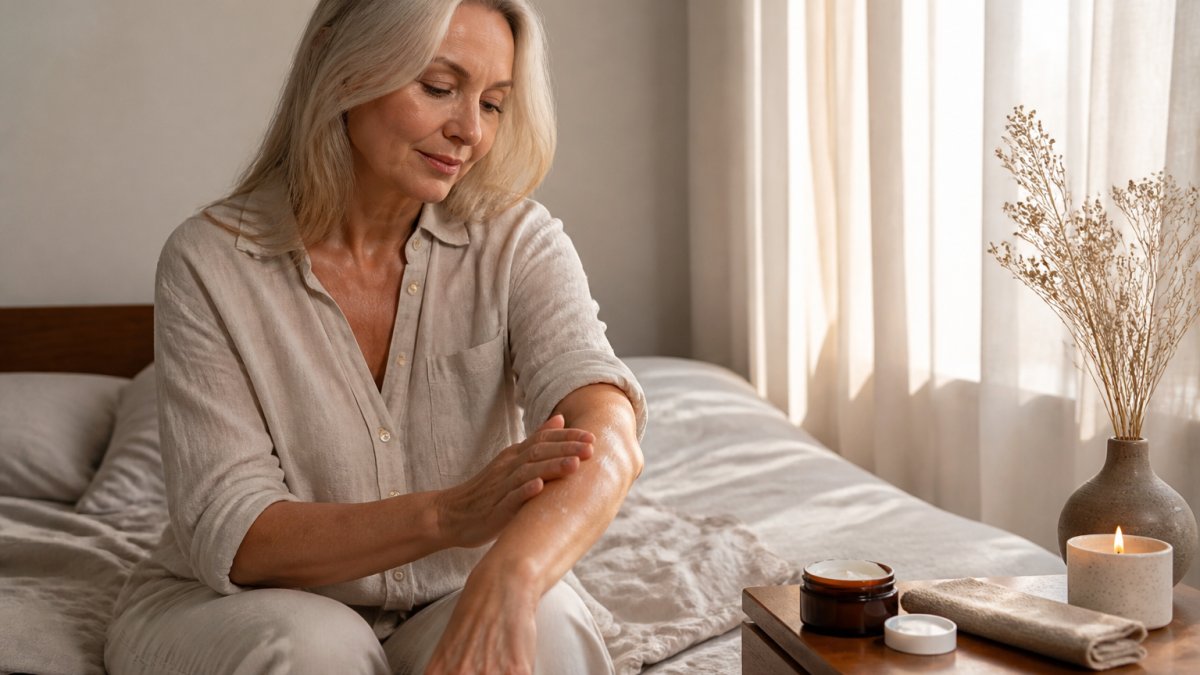
Timing matters more than technique. The best moment to apply body butter is within three minutes of stepping out of the shower, while skin is still damp and the barrier is most receptive. The reason is mechanical: an occlusive layer traps water that is already on the skin, so applying to bone-dry skin seals in almost nothing.
Here is the routine we recommend:
- Pat dry, leaving skin slightly damp. Do not rub fully dry with a towel.
- Warm a small scoop between your palms until it melts. Cold butter drags and pulls at skin.
- Press and sweep upward on legs, arms, and torso. Pressing beats rubbing for a thick butter.
- Give extra attention to elbows, knees, and heels, where the barrier is thickest and flakes most.
- Reapply to hands and any flaky patches before bed.
A little goes further than you expect with a concentrated formula, so start small and add more only where skin still feels tight.
Layering Body Butter With Other Products
Order matters when you use more than one product. The general rule is thinnest to thickest, because a heavy butter applied first will block a lighter product from reaching skin.
- Humectant first. If you use a glycerin or hyaluronic acid serum, apply it to damp skin first so it can pull water in.
- Body butter second. Apply while the humectant is still tacky, not fully dry, so the butter seals the layer underneath.
- Ointment last, only where needed. On cracked heels or fissures, a thin ointment layer over the butter adds a stronger seal.
If you use an exfoliating acid or a retinoid, apply it before the butter and give it a few minutes to absorb. A heavy butter over an active can increase irritation by trapping it against skin.
Adjusting for Season, Climate, and Skin Type
A routine that works in humid summer will feel wrong in a dry winter. Two adjustments cover most of it:
- Winter or dry climates: use the richer butter at night and a lighter whipped texture in the morning. Add a second application on hands after every wash.
- Humid climates or oily skin: a whipped or soufflé texture is usually enough. Full-strength butter on the back and chest can feel suffocating in humidity.
- Very dry or mature skin: apply twice daily, morning and night, and treat the butter as a seal over a humectant rather than as a standalone step.
That is the whole method. Consistent timing beats a complicated routine every time.
Frequently Asked Questions
What ingredients should I look for in a body butter for dry skin?
Look for barrier-supporting butters and oils that appear near the top of the ingredient list: shea, sal, kokum, or mango butter, plus emollients like meadowfoam, jojoba, avocado, or oat oil. Deep Nourish for Dry Skin, for example, lists shea, sal, and kokum butters with MCT, meadowfoam, avocado, olive, and macadamia oils. Avoid heavily fragranced formulas if your skin is reactive, and patch test anything new on your inner arm for 24 hours.
Is unscented body butter for very dry skin better than scented?
For very dry or reactive skin, unscented is usually the safer starting point. Added fragrance and essential oils are common triggers for itching and redness, which is why Calm Healing for Sensitive or Irritated Skin is made with no fragrance and no harsh actives. Once your barrier feels calm, you can introduce a scented whipped butter like Moonlit Lily or Sweet Nectar if you want, patch testing first.
How often should you apply body butter to dry skin?
Twice daily works well for most people: once in the morning and once at night. The most effective timing is within three minutes of a shower, while skin is still damp, so the butter seals in water rather than sitting on dry surface cells. For cracked heels or flaky shins, apply a thicker layer at night and let it absorb before dressing. Consistency over weeks matters more than any single application.
Can body butter help with itchy or flaky skin?
Yes, when the formula is built for it. Rich butters form a protective veil that helps skin hold onto moisture, which reduces the tightness and flaking that drive itching. Calm Healing for Sensitive or Irritated Skin pairs shea, mango, and sal butters with chamomile, borage, and evening primrose oils to soothe chronically dry, reactive skin. If itching is severe or persistent, see a doctor, since that can signal a diagnosed condition like eczema.
What makes a body butter non toxic rather than just natural marketing?
A non toxic claim should be verifiable from the label, not the front of the jar. Check for full ingredient disclosure, plant-derived emulsifiers and preservatives, and the absence of parabens, phthalates, and sulfates. Sattva Essence Organics lists every ingredient for each product and flags formulas as paraben-free, phthalate-free, and SLS/SLES-free, which lets you evaluate the actual formula instead of trusting a buzzword.


