

Last Updated: November 1, 2026
Quick Summary
A coffee sugar polish exfoliates body skin by buffing away dull surface cells with sugar and ground coffee while carrier oils seal in moisture. Use it on damp skin in the shower two to three times per week, massaging in gentle circles and rinsing with lukewarm water.
- The core ratio is two parts sugar to one part coffee, bound with enough oil to make a wet sand texture.
- Wait at least 24 hours after shaving or waxing before scrubbing.
- Patch test on the inner forearm, rinse after 30 seconds, and wait 24 hours.
- Discard homemade scrub after four weeks at room temperature, or sooner if it contains honey.
- Coffee scrubs cannot erase cellulite or stretch marks, though they can smooth rough texture.
Table of Contents
- Why a Coffee Sugar Polish Belongs in Your Body Care Ritual
- What a Coffee and Sugar Scrub Recipe Actually Needs
- How to Use Coffee Body Scrub Without Irritating Your Skin
- How Often to Exfoliate Your Body for Smooth, Soft Skin
- Making a Coffee Scrub With Coconut Oil at Home
- What Coffee Scrubs Can and Cannot Do for Your Skin
- Storing Your Polish Safely and Keeping It Fresh
- Choosing a Handcrafted Polish for Your Next Shower Ritual
- Frequently Asked Questions
Why a Coffee Sugar Polish Belongs in Your Body Care Ritual
A coffee sugar polish for exfoliating body skin earns its place in your routine because it does two jobs at once: it buffs away dull surface cells and it wakes up your senses. The global body scrub market reached USD 1.3 billion in 2025 and is projected to hit USD 1.4 billion by the end of 2026, according to Future Market Insights' body scrub market estimate. That growth tracks a simple truth: people want polished skin without harsh chemicals.
At Sattva Essence Organics and Naturals, we build our polishes around raw sugar, ground coffee, and plant oils. Here is why that trio works.
Physical exfoliation is the act of lifting dead cells from your skin's surface with a textured material.
What makes coffee sugar polish different from a plain salt scrub:
- Sugar granules dissolve as you rub, so pressure eases off naturally
- Ground coffee adds grip and a roasted scent that feels like a morning ritual
- Carrier oils stay behind on damp skin to seal in moisture
Below, we'll show you exactly how to make one, use one, and store one without wrecking your skin barrier.
What a Coffee and Sugar Scrub Recipe Actually Needs
Every good coffee and sugar scrub recipe has three parts: a particle blend, a carrier oil base, and optional extras. Get the ratio right and the rest is easy.
The core ratio most recipes follow is two parts sugar to one part coffee, bound with enough oil to make a wet sand texture. That is roughly:
- 1/2 cup raw or brown sugar
- 1/4 cup ground coffee
- 1/4 cup carrier oil, added a spoonful at a time
Stir until the mixture holds together but still crumbles. Too much oil makes a slippery paste that slides off your skin before it can exfoliate.
Choosing Your Sugar and Coffee Particles
Particle size decides how strong your scrub feels. Raw sugar and granulated sugar give a firm polish. Brown sugar is softer and dissolves faster, which suits dry or mature skin.
Coffee grounds behave differently. Fine coffee powder blends smoothly and rinses cleanly. A body scrub selection guide from Smytten advises choosing fine sugar for a softer polish and avoiding coarse scrubs on sensitive or broken skin.
Here is how the particles compare:
| Particle | Texture | Best For | Caution |
|---|---|---|---|
| Brown sugar | Soft, quick-dissolving | Dry or mature skin | Fades fast in the shower |
| Raw or granulated sugar | Medium grit | Most body skin | Skip on fresh shaves |
| Fine coffee powder | Smooth, even | First-time scrub users | Less scent intensity |
| Coarse coffee grounds | Firm, textured | Thick skin, elbows, knees | Too rough for sensitive skin |
Carrier Oils, Honey, and Optional Add-Ins
Carrier oils do the moisturizing work. Coconut oil, olive oil, sweet almond oil, and jojoba all work, and each behaves a little differently.
- Fractionated coconut oil stays liquid and absorbs quickly
- Sweet almond oil is light and good for most skin types
- Olive oil is heavier, better for very dry legs and feet
Honey adds a humectant quality that pulls water toward your skin. Vanilla or a drop of essential oil rounds out the scent. Skip honey if you want a longer shelf life, since it adds water content.
How to Use Coffee Body Scrub Without Irritating Your Skin
Use coffee body scrub on damp skin in the shower, massage it in gentle circles, then rinse with lukewarm water.
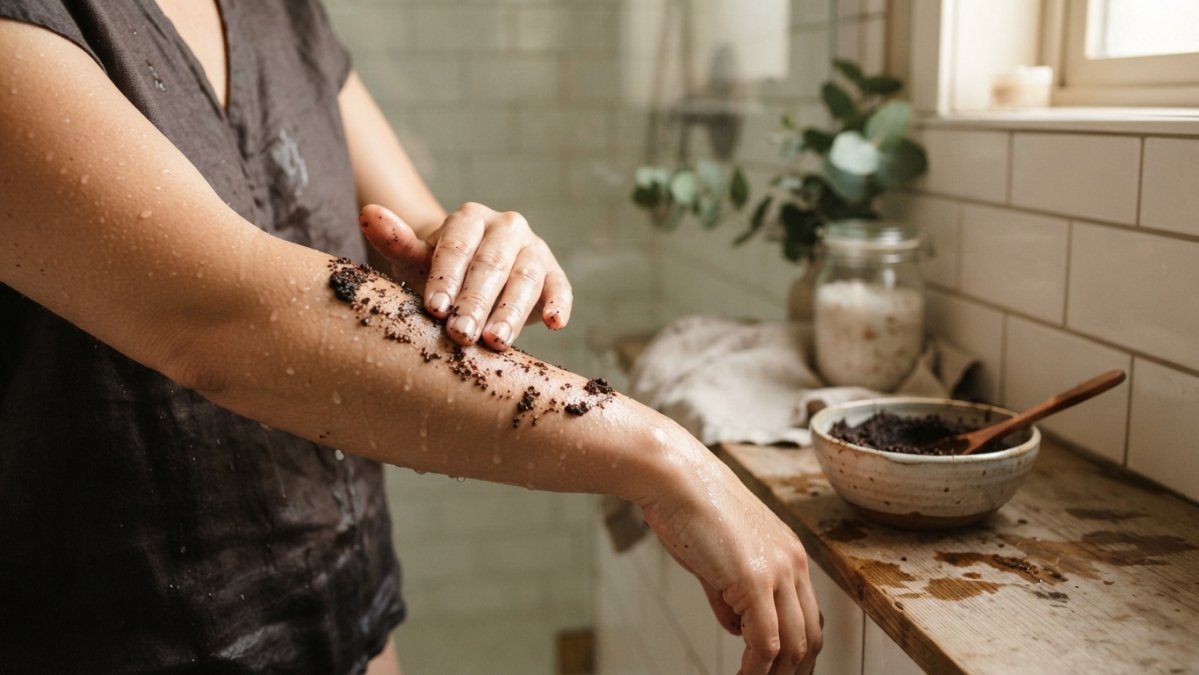
Follow this order:
- Shower so skin softens
- Scoop a small amount into your hand, not the jar
- Massage in gentle circles
- Rinse with lukewarm water
- Pat dry and apply lotion
Watch out: scrubbing right after shaving or waxing opens micro-cuts and stings badly. Wait at least 24 hours.
Patch Test Before Your First Full Use
Before you scrub your whole body, run a patch test. Apply a small amount to the inner forearm, rinse after 30 seconds, and wait 24 hours. If you see redness, stinging, or a rash, stop and do not use the scrub on larger areas.
Pressure and Particle Size Decide How Abrasive It Feels
Abrasion is a function of two things: how sharp the particles are and how hard you press. Fine coffee powder and brown sugar feel gentle because the grains are small and round off quickly. Coarse coffee grounds and raw sugar stay angular longer, so they cut more. You can soften any batch without changing the recipe by pressing lighter and moving faster, short, light passes abrade less than slow, heavy ones.
Who Should Skip Physical Scrubs
Physical exfoliation is not right for every body or every moment. Skip it, or ask a dermatologist first, if you have:
- Active eczema, psoriasis, or dermatitis flare-ups
- Sunburn, windburn, or any broken, cracked, or bleeding skin
- A rash of unknown cause
If you are unsure, treat a small area first and give it a day before expanding.
Body-Area Guidance
Thicker skin tolerates more. Elbows, knees, heels, and the backs of the arms can take a firmer scrub. Delicate areas need a lighter hand or none at all:
- Neck and chest: light pressure only; skin here is thin
- Inner arms and inner thighs: light pressure, short passes
- Face: do not use a body scrub on your face
For a deeper walkthrough of scrub technique, see our guide on how to use a sugar scrub for smoother skin texture.
How Often to Exfoliate Your Body for Smooth, Soft Skin
Exfoliate your body two to three times per week if your skin tolerates it. Sensitive or mature skin often does better with once or twice weekly. More is not better here.
The reason is simple. Physical exfoliation removes the outer layer of dead cells. Do it daily and you start stripping the healthy barrier underneath, which leads to tightness, redness, and flaking.
Invigorating Coffee Sugar Polish — Net Wt. 8 oz →
Signs you are overdoing it:
- Skin feels tight right after the shower
- Redness that lasts more than an hour
- Stinging when you apply lotion
Treat your body in zones. If you are building a weekly ritual, our guide on how to build a relaxing evening bath routine at home pairs well with a Sunday exfoliation habit.
Making a Coffee Scrub With Coconut Oil at Home
A coffee scrub with coconut oil takes about five minutes to mix and makes enough for three or four showers. Keep it in the fridge if your kitchen runs warm.
What you need:
- 1/2 cup brown or raw sugar
- 1/4 cup fine ground coffee
- 1/4 cup fractionated coconut oil, plus a little extra
Steps:
- Combine the sugar and coffee in a bowl
- Pour in the coconut oil and stir until evenly coated
- Add honey and vanilla if using, then stir again
- Add more oil one teaspoon at a time until the mix clumps softly
- Spoon into a clean jar and seal
A 2024 study in Applied Sciences on waterless scrub formulations tested five solid body scrubs built on natural exfoliants including sugar and ground materials, which supports what home mixers already know: sugar and coffee hold up well in a low-water formula.
What Coffee Scrubs Can and Cannot Do for Your Skin
Coffee scrubs can smooth rough texture, lift dullness, and leave skin feeling softer. They cannot erase cellulite or stretch marks. That distinction matters, because plenty of marketing blurs it.
The caffeine in coffee may help temporarily tighten the look of skin, and the massage action supports circulation. But Byrdie's review of coffee scrub claims notes that the evidence does not establish that coffee scrubs reduce cellulite or stretch marks.
What you can honestly expect:
- A smoother feel after use
- A brighter look on knees, elbows, and shoulders
- A scent and ritual that makes the shower feel intentional
What you should not expect:
- Permanent changes to skin firmness
- Removal of scars or dark spots
- Weight loss or "detox" effects
Storing Your Polish Safely and Keeping It Fresh
Store your scrub in a sealed glass jar, keep water out of it, and use a dry spoon every time.
Water is the enemy. Every wet finger that dips into the jar introduces bacteria and shortens shelf life. Scoop with a clean spoon into your hand, then close the lid.
Three storage rules worth following:
- Keep the jar out of direct shower spray
- Store in a cool spot, or refrigerate in summer
- Smell it before each use, and toss it if the oil turns rancid
Mix Small Batches
The simplest way to keep a homemade scrub fresh is to make less of it. A half-cup batch lasts about three or four showers, which is long enough to enjoy and short enough that you finish it before it turns. Small batches also let you adjust the recipe, more oil, finer coffee, without committing a whole jar to a texture you do not love.
Why Water Contamination Matters
A sugar-and-oil scrub has little water in it, and that is what keeps it stable. Introduce water, a wet hand, a dripping scoop, a jar left open under the showerhead, and you create pockets where bacteria and mold can grow. The oil does not protect against this; in fact, oil can trap moisture against the sugar. The practical fix is mechanical: a dry spoon, a closed lid, and a jar that lives outside the spray zone.
Container Choice
A glass jar with a tight-fitting lid is a practical choice for storing a scrub.
Shelf Life and When to Discard
Use these signs as your discard checklist:
- Smell: a sharp, sour, or paint-like odor means the oil has gone rancid
- Texture: separation that will not stir back together, or a grainy, watery layer
- Surface: any fuzz, discoloration, or film on top
When in doubt, throw it out. A fresh batch costs a few minutes and a handful of pantry ingredients.
If you would rather not mix your own, a handcrafted polish removes the guesswork. Our Invigorating Coffee Sugar Polish is made in small batches with raw sugar, ground coffee, shea, mango butter, jojoba, sunflower, and fractionated coconut oils, and it is preserved with Eco-certified Geogard ECT.

Choosing a Handcrafted Polish for Your Next Shower Ritual
Choose a handcrafted polish by reading the ingredient list, checking the particle size, and confirming how it is preserved.
If you are comparing handcrafted vegan sugar polishes before buying,
Our own Invigorating Coffee Sugar Polish comes in an 8 oz jar at $30.00. For a softer, cozier option, the Warm Vanilla Whipped Sugar Scrub at $22.99 has a whipped texture. You can also browse the Summer Polish to see seasonal options.
Frequently Asked Questions
How do you make a coffee and sugar body polish?
Combine one cup of raw or brown sugar with half a cup of ground coffee, then stir in enough carrier oil, about half a cup, to reach a wet sand texture. Add a spoonful of honey or a splash of vanilla if you like. Mix in a bowl, transfer to a jar with a tight lid, and use within two weeks. Keep the ratio roughly two parts sugar to one part coffee so the polish stays scrubby without turning abrasive.
Should you use a coffee scrub on wet or dry skin?
Damp skin is the safer choice. Step into a warm shower, let your skin get wet, then apply the coffee sugar polish in circular motions before you soap up. Water softens the sugar crystals slightly so they glide instead of dragging. Dry-skin application concentrates the friction in one spot and is more likely to leave redness, especially on arms, thighs, and anywhere the skin is thin.
How often should you use a coffee sugar body scrub?
Two to three times a week suits most body skin. If your skin is sensitive or mature, start with once a week and watch how it responds over two weeks. Signs you are overdoing it include tightness after the shower, flaking between uses, or stinging when you apply lotion. Cut back to once a week and skip any area that feels raw or looks irritated.
Can you use a coffee and sugar scrub on your face?
Skip the face. Coffee grounds and coarse sugar crystals are too abrasive for facial skin, which is thinner and more reactive than the body. Keep both sugar and coffee scrubs away from the face. Use a dedicated fine-grained facial exfoliant instead, and keep your coffee sugar polish from the neck down.
Your skin does not need a ten-step routine. It needs a polish that exfoliates without stripping and a habit you will actually keep. Sattva Essence Organics and Naturals makes that easy with small-batch, frequency-infused polishes built on natural botanicals, vegan formulas, and cruelty-free sourcing. Get started with Sattva Essence and turn your next shower into a ritual your skin looks forward to.


