

Last Updated: November 3, 2026
Quick Summary
To source ethical botanical ingredients, verify four pillars: origin and cultivation, harvest limits, fair labor, and traceability. Demand chain-of-custody documents and a batch-specific certificate of analysis, and match each certification to the specific ingredient rather than trusting a logo.
- Plant-based personal-care launches grew at a 9% compound annual growth rate between July 2021 and June 2026.
- Ask suppliers for six chain-of-custody documents, including harvest records and a batch-specific certificate of analysis.
- USDA Organic verifies growing and processing inputs but not labor conditions, harvest limits, or species impact.
- Screen wild-harvested species against the IUCN Red List and CITES appendices before committing to a purchase.
- Score suppliers 1 to 5 on each checklist line and require a minimum total before a first order.
Table of Contents
- What Ethical Botanical Ingredients Actually Mean
- Sustainable Botanical Ingredient Sourcing: The Four Pillars
- Botanical Ingredient Traceability From Farm to Factory
- Questions to Ask Botanical Suppliers Before You Order
- Certifications Compared, and Where Each One Stops
- Wild Harvesting, Biodiversity, and Supply Resilience
- Ethically Sourced Skincare Ingredients: What Buyers Should See on a Label
- Build Your Own Botanical Sourcing Checklist
- Frequently Asked Questions
What Ethical Botanical Ingredients Actually Mean
Ethical botanical ingredients are plant-derived raw materials grown, harvested, processed, and traded under conditions that protect ecosystems, workers, and the integrity of what ends up in the jar. The market is moving fast: according to Personal Care Insights' reporting on plant-based personal-care launches, plant-based personal-care launches grew at a 9% compound annual growth rate between July 2021 and June 2026, and a global botanical ingredients market valued at $200.4 billion in 2025 shows no sign of contracting.
At Sattva Essence Organics and Naturals, we formulate with natural botanicals in small batches. The uncomfortable part most guides skip: "natural" and "ethical" are not regulated synonyms. Natural describes origin; ethical describes conduct.
Below, we break down how to source ethical botanical ingredients using four pillars, the documents to demand, and the certification gaps nobody warns you about.
Sustainable Botanical Ingredient Sourcing: The Four Pillars
Sustainable botanical ingredient sourcing rests on four pillars: origin and cultivation, harvest limits, fair labor, and traceability.
- Origin and cultivation: Where the plant was grown, and whether it was farmed or collected wild
- Harvest limits: Whether collection rates allow the species and ecosystem to regenerate
- Fair labor: Wages, safety, and community benefit at the farm and processing level
Origin, Cultivation, and Harvest Limits
Origin is the first filter, not the last. A supplier who cannot name the country, region, and farm type for a botanical extract either does not know or will not say, both disqualifying for a premium claim.
Harvest limits are where the conversation gets serious. Wild collection has no replanting budget. If a supplier cannot describe how collection volumes are capped or monitored, assume the cap is whatever the buyer orders.
Fair Labor and Community Livelihoods
Fair labor practices are the pillar buyers verify least and regulators scrutinize most. A HerbalGram case study on regenerative turmeric farming and ethical trade partnerships in Nicaragua documents how regenerative growing and trade partnerships operate in practice, though the published summary does not report a measurable outcome.
That absence is instructive. Ethical sourcing claims often outrun the evidence behind them.
Botanical Ingredient Traceability From Farm to Factory
Botanical ingredient traceability is the documented ability to follow a raw material from a specific harvest through processing, transport, and formulation. Without it, every other ethical claim is unverifiable.
The authentication problem is real. A review of chemical authentication methods covering 2,386 commercial herbal products sold in 37 countries examined how laboratories verify that botanical products contain what labels claim.
Traceability proves the paperwork chain; authentication proves the material itself. You need both, because a clean paper trail attached to adulterated extract is still adulteration.
Chain-of-Custody Documents to Request
Ask for these before any purchase order:
- Farm or collector identification with region and harvest dates
- Harvest permits or collection records for wild-harvested material
- Processing facility name and location, not just the trading company
- Batch-specific certificate of analysis matching your lot number
- Chain-of-custody statement naming each handler in sequence
- Species verification via botanical or chemical authentication
If a supplier supplies five of six and stalls on the sixth, you have found the weak link in their supply chain. Ask why.
Questions to Ask Botanical Suppliers Before You Order
The fastest way to separate serious suppliers from resellers is a structured set of questions to ask botanical suppliers. Ask in writing and compare answers side by side.
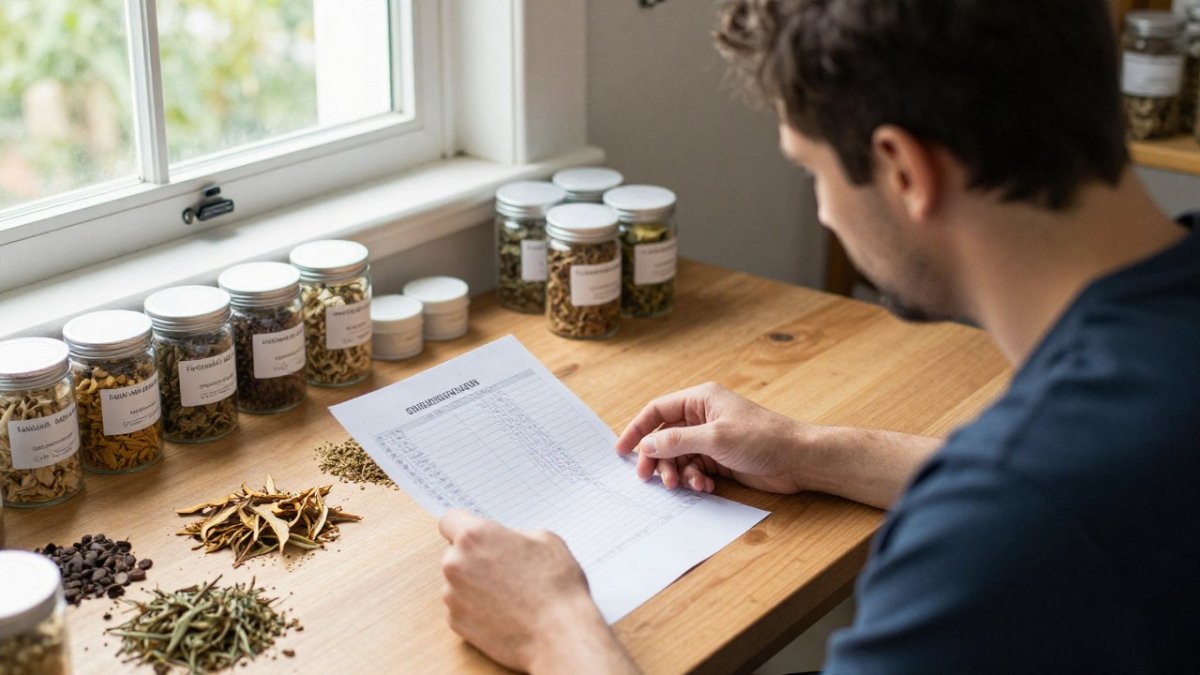
Here is the exact list we would send:
- Which farm, cooperative, or collection region produced this batch?
- Was the material cultivated or wild-harvested?
- What harvest limits or regeneration practices apply?
Certifications Compared, and Where Each One Stops
Certifications verify specific things and stay silent on everything else. The useful skill is knowing which question each certificate answers, and which it leaves for you to ask.
What Each Scheme Actually Verifies
| Certification type | What it verifies | What it does not verify |
|---|---|---|
| USDA Organic | Growing and processing inputs against the National Organic Program rule; prohibits most synthetic pesticides and fertilizers and requires recordkeeping | Labor conditions, harvest limits, or species impact |
| Fair trade (e.g., Fairtrade International, Fair Trade USA) | Trade terms, minimum prices, worker welfare, and in some standards a community development premium | Species or ecosystem impact; downstream chain of custody |
| Sustainability standards (e.g., Rainforest Alliance, Union for Ethical BioTrade) | Farm-level environmental practices, and in some standards social criteria and continuous improvement | Full chain of custody beyond certified entities; harvest limits for wild species |
| Supplier-level farm certification | That a named farm meets a named standard at the time of audit | Other farms in the same blend; brokers and processors downstream |
A supplier waving a logo is answering one question. Your job is to know which one. The table above is a starting point, not a verdict, because the scope of each scheme depends on the specific standard version and the certifying body.
Where the Gaps Bite
Organic certification is the most commonly misunderstood. A USDA Organic certificate tells you how the crop was grown and handled.
Fair-trade certification is strong on labor and trade terms and weak on ecology.
Sustainability standards vary widely. Some cover only farm-level practices and stop at the farm gate, leaving the broker, processor, and blender outside the audit.
Supplier-level farm certification is the narrowest.
When You Need an Audit Beyond the Certificate
A certificate is a point-in-time verification by a third party. An audit is your own verification of the specific claim you intend to make. You need an audit beyond the certificate when any of the following is true:
- The certificate covers a different entity than the one shipping your material.
- The certificate covers a different ingredient or product form than the one you are buying.
- Your supply chain includes brokers or processors outside the certified scope.
Request the certificate, the audit report summary if available, the scope statement naming the certified entity and products, and the current validity dates.
Watch out: a certificate that names a parent company or trading arm does not automatically cover the farm or the specific lot you are buying. Match the certified entity name on the certificate to the entity on your purchase order.
A Comparison Routine You Can Repeat
For each ingredient, build a one-page certification file with four lines: the standard name and version, the certified entity, the products covered, and the validity dates. Then add a fifth line: the claim you intend to make and whether the certificate supports it. If the fifth line is blank, you have a gap to close before you order.
Calm Healing for Sensitive or Irritated Skin (Organic Line) →
If you want to pressure-test label claims before you trust them, our guide on how to identify greenwashing in organic skincare walks through the verification steps we use.
Wild Harvesting, Biodiversity, and Supply Resilience
Wild harvesting is the highest-risk sourcing model in botanicals, and it is also where the most beautiful ingredient stories live. Collection from wild populations can support local livelihoods and preserve genetic diversity, or strip a species faster than it regenerates.
A wild-harvested botanical with no collection monitoring is a supply chain with a hidden expiration date: when the population crashes, your formula crashes with it.
Harvest Limits and Regeneration Monitoring
A harvest limit is a cap on how much material can be collected from a defined area in a defined period without impairing the species' ability to regenerate.
Regeneration monitoring is the proof that the limit works, typically via tagged plots, annual counts, or regeneration surveys tracking seedling survival and stand density over time.
Watch out: a supplier may present a harvest permit as evidence of sustainability when the permit only authorizes collection and says nothing about volume relative to regeneration.
Threatened-Species Screening
Before you commit to a wild-harvested botanical, screen the species against public conservation lists. The two most useful references are the IUCN Red List of Threatened Species, which assigns global extinction-risk categories, and the Convention on International Trade in Endangered Species of Wild Fauna and Flora (CITES), which regulates cross-border trade in listed species.
A practical screening routine looks like this:
- Confirm the exact scientific name, including genus and species, because common names overlap across unrelated plants.
- Check the IUCN Red List status. A listing of Vulnerable, Endangered, or Critically Endangered requires a documented conservation justification before purchase.
- Check CITES appendices. Appendix I generally prohibits commercial trade; Appendix II requires export permits and a finding that trade will not harm the species.
- Ask the supplier for their own species-level risk assessment, not a generic sustainability statement.
- If the species is unlisted, document that finding and revisit it annually, because statuses change.
A supplier who has already screened the species will have answers ready.
Community Stewardship and Benefit-Sharing
Wild harvesting that survives commercially usually does so because the collecting community has a reason to protect the resource. That reason is rarely sentiment.
Ask how collectors are paid and whether the payment structure rewards restraint. A per-kilogram price with no ceiling rewards volume, the opposite of conservation. A contract that pays for a defined sustainable volume, plus a premium for monitoring data, aligns the collector's interest with the plant's survival.
Supply Resilience Follows the Same Logic
Cultivated material with documented farm relationships tends to survive climate shocks and crop failures better than anonymous wild collection. Ask every supplier what happens in a bad harvest year.
Resilience also depends on genetic diversity. A cultivated crop grown from a narrow genetic base is vulnerable to disease in a way a well-managed wild population is not.
Ethically Sourced Skincare Ingredients: What Buyers Should See on a Label
Ethically sourced skincare ingredients should be identifiable, not implied. Naming the ingredient, origin, and standard makes ethically sourced ingredients easier to assess across categories, including the sourcing of coffee beans.
What to look for on a finished product label:
- Named botanical ingredients rather than vague "botanical extract" catch-alls
- Specific certifications tied to specific ingredients
- Origin disclosure where the brand makes an origin claim
For a plain-English breakdown of what individual botanicals actually do for skin, our guide to the six skin-loving ingredients in our body butters explains shea butter, rosehip, turmeric, and frankincense without the jargon.
Build Your Own Botanical Sourcing Checklist
Here is the practical asset. Score each supplier from 1 to 5 on every line, and require a minimum total before you place a first order.
| Criteria | What to verify | Weight |
|---|---|---|
| Origin disclosure | Farm, region, and cultivation type named | High |
| Harvest documentation | Permits or collection records provided | High |
| Chain of custody | Every handler documented in sequence | High |
| Authentication | Batch-specific species verification | High |
| Labor standards | Fair-trade or equivalent accreditation | Medium |
| Certification scope | Standard tied to the specific ingredient | Medium |
| Commercial terms | MOQ, lead time, and seasonal availability stated | Medium |
| Contingency plan | Documented response to crop failure | Medium |
Two rules we would enforce. First, no single certification substitutes for origin and chain-of-custody documentation. When you are ready to see the finished result, explore our Sattva Silk Butters from the Sattva Signature line. Second, if a supplier cannot state lead times and minimum order quantities in writing, they are not ready for a recurring relationship.
Sourcing botanicals well takes more documentation than most buyers expect, and that friction is the point. Sattva Essence Organics and Naturals offers small-batch, handcrafted products made with natural botanicals, vegan and cruelty-free formulations, and frequency-infused rituals.
Frequently Asked Questions
What are ethically sourced ingredients?
Ethically sourced ingredients are raw materials bought with documented attention to how they were grown or harvested, who did the work, and what happened to the land and community along the way. In practice that means a named origin, a supplier who can show harvest records, fair pay and safe conditions for workers, and compliance with United States import rules such as the Lacey Act, which bans illegally harvested plants.
How do I verify that ethical botanical ingredients are what the supplier claims?
Ask for three things and check that they agree with each other: the certificate of analysis listing identity and purity, the harvest or lot number on that certificate, and the chain-of-custody record linking that lot to a specific farm or cooperative. Then confirm the supplier's organic certificate covers the exact ingredient and the exact handling operation, not just the farm. Where identity matters, request third-party authentication testing.
What is the difference between sustainable and ethical sourcing?
Sustainable sourcing focuses on the resource: whether the plant can be harvested at the current rate without damaging the species or ecosystem, and whether cultivation practices protect soil and biodiversity. Ethical sourcing focuses on people and honesty: fair pay, safe working conditions, no child labor, community consent, and claims that match reality. You need both. A certified organic farm can still underpay its pickers, and a fair-trade cooperative can still harvest a slow-growing species faster than it regenerates. Treat the two as separate questions on your supplier audit.
What should small skincare brands ask botanical ingredient suppliers?
Ask for the country and region of origin, the farm or cooperative name, the harvest date and season, and whether the material is cultivated or wild harvested. Request the certificate of analysis, the safety data sheet, and the organic or fair-trade certificates with the scope pages attached. Then ask about minimum order quantities, lead times, and what happens when a crop fails. Finally, ask who physically handled the material between farm and warehouse. Suppliers with real traceability answer these quickly; suppliers reselling from a broker tend to go quiet at the fourth question.
How can brands trace botanical ingredients back to their source?
Traceability runs on lot numbers. Every purchase should carry a lot or batch code that appears on the certificate of analysis, the packing list, and the supplier's own inbound record from the farm or cooperative. Ask for the name and location of the growing operation, the harvest window, and the processing facility where drying or extraction happened. Where a supplier buys through intermediaries, ask them to name each step in the chain.
Does an organic certification guarantee ethical sourcing?
No. Organic certification verifies growing and handling practices, such as prohibited pesticides and separation from conventional crops. It does not verify wages, housing, child labor rules, or whether wild harvest rates protect the species. Fair-trade certification addresses some labor and pricing questions but usually applies to specific commodities and specific cooperatives, not to every ingredient a supplier sells. Read the scope of each certificate, and treat certification as one input rather than the answer.
Why does wild harvesting carry more risk than cultivated botanicals?
Wild harvesting removes plants from an ecosystem with no replanting guarantee, and slow-growing species can be depleted before anyone notices. Harvest limits, permits, and species-level monitoring are what keep wild collection viable, and not every supplier tracks them. Cultivated material gives you more control over variety, harvest timing, and volume, though it brings its own risks around pesticide use and land conversion. Ask any wild-harvest supplier for the harvest plan, the permitted volume, and evidence that regeneration is being monitored.


